

Deep Groove vs Roller Bearings: Key Differences in Industrial Applications
Deep groove ball bearings and roller bearings are both widely used across industrial applications, but they are designed to solve different operational challenges. While one focuses on smooth high-speed rotation and versatility, the other is built to support heavier load conditions and increased durability under stress.
Understanding the differences between these bearing types helps industries improve machine reliability, reduce maintenance issues, and choose solutions better suited to actual operating conditions. This guide explains how both bearing designs function, where they are commonly used, and what factors influence selection in industrial environments.
Why Different Bearing Designs Exist in Industrial Machinery
Industrial machines do not operate under identical conditions. Some systems require high rotational speed with minimal friction, while others operate under heavy radial loads and continuous stress. Because operating conditions vary significantly from one application to another, a single bearing design cannot efficiently solve every mechanical challenge.
This is why different bearing types exist. Each design is developed to handle specific operating requirements such as load direction, rotational speed, alignment variation, and environmental exposure. Selecting the correct bearing type is less about preference and more about matching the bearing structure to the actual working condition of the machine.
In many general industrial systems where speed, smooth operation, and versatility are important, industries often rely on deep groove ball bearings because of their balanced operational characteristics.
On the other hand, systems exposed to heavier loads or shock conditions often require roller bearing designs that distribute force differently to improve durability and load capacity.
How Bearing Geometry Changes Performance
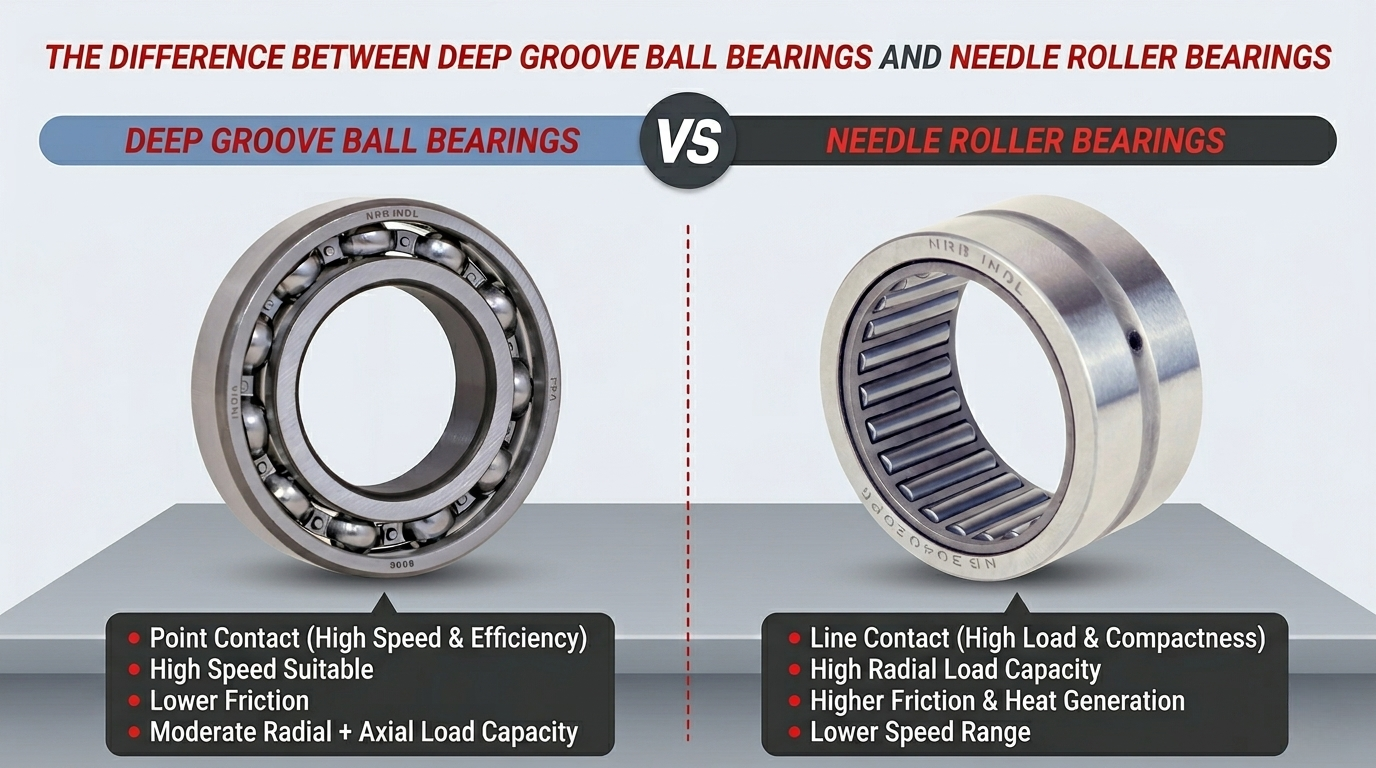
The internal structure of a bearing directly affects how load is distributed during operation. Ball bearings use point contact between rolling elements and raceways, while roller bearings use line contact. This difference significantly changes how force is handled inside the bearing assembly.
Because of point contact, ball bearings generate less friction and operate efficiently at higher rotational speeds. Roller bearings, however, distribute load over a larger surface area, allowing them to handle heavier stress conditions more effectively.
Why Selection Depends on Operating Conditions
Bearing selection is rarely based on dimensions alone. Engineers evaluate speed, load direction, vibration levels, lubrication conditions, and expected operating cycles before selecting the appropriate type.
Using the wrong bearing in the wrong environment often creates gradual operational problems that reduce machine efficiency and increase maintenance frequency over time.
Understanding Deep Groove Ball Bearings and Their Operating Characteristics
Deep groove ball bearings are among the most commonly used bearing types in industrial machinery because of their versatility and smooth rotational performance. Their design allows them to support both radial and moderate axial loads while operating efficiently at higher speeds.
One of the main reasons industries use these bearings extensively is their ability to perform reliably across a broad range of applications without requiring highly specialized operating conditions. They are frequently used in electric motors, pumps, fans, conveyors, and general rotating equipment where stable movement and reduced friction are essential.
Their comparatively simple structure also supports easier integration into multiple industrial systems. In environments where machines operate continuously, maintaining smooth rotational efficiency becomes critical for reducing energy loss and minimizing wear on surrounding components.
Why Deep Groove Bearings Perform Well at Higher Speeds
Because ball bearings create smaller contact areas during rotation, friction levels remain lower compared to roller bearing designs. Lower friction allows smoother rotational performance and reduced heat generation during high-speed operation.
This makes deep groove ball bearings highly suitable for applications where rotational efficiency and speed consistency are important operational priorities.
Where Deep Groove Bearings Are Commonly Used
These bearings are commonly installed in motors, pumps, compressors, fans, and various industrial machines where moderate loads and continuous operation are expected. Their versatility allows them to function across multiple sectors without major design adjustments.
For industries evaluating sourcing decisions, understanding how a deep groove ball bearings manufacturer in India ensures quality consistency and application suitability can support better long-term procurement decisions.
Operational Advantages in General Industrial Systems
Deep groove ball bearings are often selected because they balance efficiency, reliability, and operating simplicity. Instead of requiring highly controlled environments, they adapt well to many industrial applications where stable performance is required over long durations.
Their widespread adoption reflects their ability to support practical industrial requirements rather than only theoretical performance advantages.
How Roller Bearings Differ in Load Handling and Structural Design
Roller bearings are designed primarily for applications where load-carrying capacity becomes more important than rotational speed alone. Unlike ball bearings, roller bearings use cylindrical or tapered rolling elements that create line contact with raceways instead of point contact.
This larger contact area allows roller bearings to distribute loads more effectively, making them suitable for heavier radial load conditions and high-stress industrial environments. Because force is spread across a broader surface, roller bearings can handle significantly higher loads without excessive stress concentration.
These characteristics make roller bearings common in heavy-duty machinery, industrial gearboxes, construction equipment, steel plants, mining systems, and applications involving shock loads or continuous heavy operation.
Why Roller Bearings Handle Higher Loads
The line contact structure inside roller bearings distributes pressure more evenly during operation. This reduces localized stress points and improves the bearing's ability to support heavy loads over extended periods.
Because of this design advantage, roller bearings are preferred in systems where durability and load capacity are more critical than rotational speed.
Trade-Off Between Load Capacity and Speed
While roller bearings offer higher load-handling capability, they generally operate at lower speeds compared to deep groove ball bearings. Increased contact surface area creates more friction and heat during rotation.
This trade-off is important because applications requiring high-speed efficiency may not benefit from heavier roller bearing designs unless load conditions demand it.
Where Roller Bearings Become Necessary
In systems operating under high radial stress, shock loading, or continuous heavy-duty conditions, standard ball bearings may not provide sufficient durability. Roller bearings become necessary because they are structurally better suited for such environments.
This allows industrial machinery to maintain reliability even under demanding operational cycles.
Speed, Friction, and Heat Generation — A Major Difference Between Both Bearing Types
One of the most important differences between deep groove ball bearings and roller bearings is how they behave during continuous rotation. Friction levels, heat generation, and operating speed all change significantly depending on the bearing structure.
Because deep groove ball bearings use point contact, rotational resistance remains comparatively low. This helps maintain smoother movement, lower operating temperatures, and better energy efficiency in high-speed applications. Machines operating continuously at elevated RPM often depend on these characteristics for stable performance.
Roller bearings, however, generate more friction because of their larger contact surfaces. While this improves load distribution, it also increases heat generation during operation. In systems operating at lower speeds with heavier loads, this trade-off becomes acceptable because durability is prioritized over rotational efficiency.
| Factor | Deep Groove Ball Bearings | Roller Bearings |
|---|---|---|
| Contact Type | Point contact | Line contact |
| Load Capacity | Moderate radial + axial | High radial load |
| Speed Performance | High speed suitable | Lower speed range |
| Friction Level | Lower friction | Higher friction |
| Heat Generation | Lower | Higher |
| Typical Applications | Motors, pumps, fans, compressors | Gearboxes, mining, steel plants |
Why Heat Generation Impacts Bearing Life
Excessive heat affects lubrication stability, internal clearances, and rolling surface integrity. Over time, elevated temperatures accelerate wear and reduce overall bearing lifespan.
Managing thermal behavior becomes essential for maintaining reliability in continuously operating systems.
How Friction Influences Energy Efficiency
Higher friction levels increase energy consumption because machines require more force to maintain rotational movement. In large industrial systems, even small efficiency losses accumulate over long operating cycles.
This is why lower-friction bearing designs are often preferred in high-speed applications focused on energy efficiency.
Which Bearing Type Is Better for Industrial Applications?
There is no universal answer to whether deep groove ball bearings or roller bearings are better because both are designed for different operating conditions. The correct choice depends entirely on how the machine functions and what stresses it experiences during operation.
Applications prioritizing higher rotational speed, smoother movement, and operational versatility often benefit from deep groove ball bearings. Their ability to operate efficiently under moderate loads makes them ideal for general industrial systems where consistency and speed are important.
Applications involving heavy radial loads, shock stress, or demanding operational conditions often require roller bearings because of their superior load-carrying capability. In such systems, durability and structural strength become more important than speed efficiency alone.
Selecting the correct bearing therefore requires understanding not just the machine itself, but also the environment, load conditions, operating cycles, and maintenance practices surrounding the application.
Why Application-Based Selection Prevents Failures
Choosing bearings based only on dimensions or availability often creates long-term operational issues. Bearings that are not suited to actual working conditions gradually develop wear, vibration, and efficiency problems.
Application-focused selection improves reliability and reduces unexpected downtime.
Long-Term Reliability Depends on Correct Matching
Bearings perform best when their structural design aligns with operational requirements. Proper matching between load conditions and bearing capability significantly improves service life.
This also helps reduce maintenance frequency and improves overall machine performance over time.
Understanding the Difference Helps Improve Industrial Reliability
Deep groove ball bearings and roller bearings are both essential to industrial systems, but they solve different mechanical challenges. One focuses on rotational efficiency and versatility, while the other prioritizes load distribution and durability under stress.
Understanding these differences helps industries make more informed decisions during equipment design, maintenance planning, and procurement. Instead of treating bearings as interchangeable components, businesses can approach selection based on actual operational requirements.
In the long run, correct bearing selection improves machine reliability, reduces maintenance costs, minimizes downtime, and supports more stable industrial operations across demanding environments.