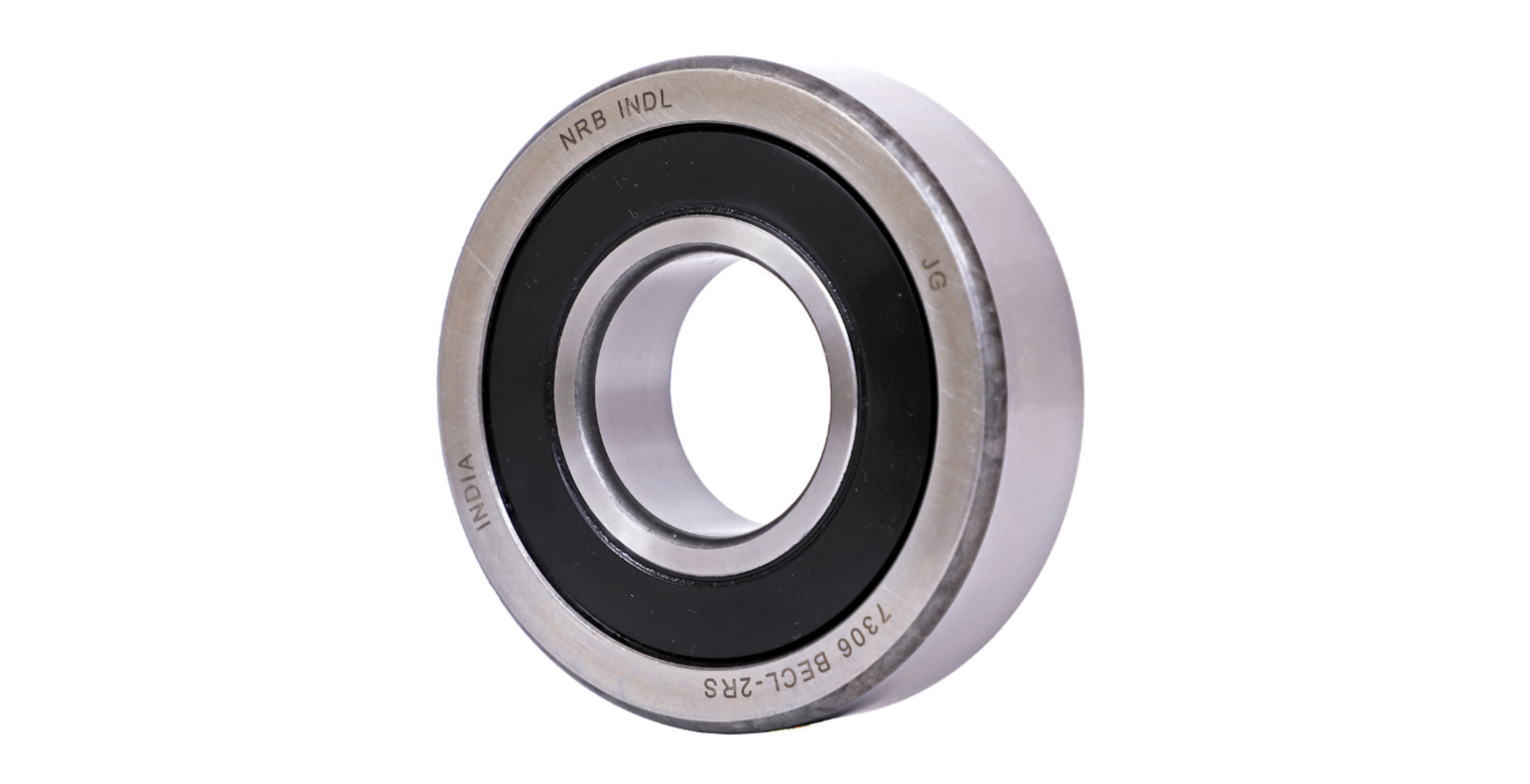
NRB Industrial Bearings offers single row angular contact ball bearings with a 40° contact angle, engineered to carry higher axial loads in one direction along with radial loads. The 40° contact angle enables improved thrust load capability compared to smaller contact angles, making these bearings a preferred choice for applications requiring rigidity, controlled shaft positioning, and stable running at high speeds. Angular contact ball bearings are commonly used in matched bearing arrangements to achieve the desired stiffness and to support axial loads in both directions. With correct pairing and mounting, they help improve running stability, reduce unwanted axial movement, and support consistent performance in demanding industrial environments such as machine tools, pumps, gearboxes and textile machinery.
These series options help designers select bearings based on required load rating, mounting space, and speed. Choosing the right series is important for matching housing/shaft dimensions and achieving long bearing life under combined loading.
Single row angular contact ball bearings support axial load in one direction, so they are typically mounted in pairs or sets to support axial load in both directions and increase system stiffness. Correct arrangement also improves shaft guidance and helps achieve reliable performance in high-speed rotating equipment.
In a back-to-back arrangement (DB), the contact lines diverge outward. This configuration provides high stiffness and good moment load capacity, making it suitable where the shaft needs strong guidance and stable positioning under combined loads.
In a face-to-face arrangement (DF), the contact lines converge inward. This arrangement can better tolerate small alignment variations and is often selected where mounting conditions may introduce minor misalignment while still requiring effective axial support.
A tandem arrangement (DT) places bearings so that axial load capacity is increased in one direction. This is useful when the application has predominant thrust load in one direction and needs higher axial load carrying capability without changing the overall design concept. Selecting the arrangement depends on factors such as load direction, moment loads, required stiffness, space constraints, and alignment conditions in the machine design.
This size coverage supports a wide range of industrial assemblies—from compact high-speed units to heavier duty rotating mechanisms requiring higher thrust and radial load capability.
Cage selection impacts speed capability, stability, lubrication behaviour, and durability under load. NRB Industrial Bearings provides cage options to suit different operating conditions, lubrication practices, and duty cycles—helping match the bearing to your application requirements.
Angular contact ball bearings with polyamide cages are preferred for smooth running and low-noise operation. They are suitable where efficient rotation and stable performance are required under regular industrial conditions. Polyamide cages are commonly selected in applications where high-speed operation and smooth running characteristics are important.
Angular contact ball bearings with machined brass cages are chosen for higher strength and dependable performance in tougher duty cycles. They offer stable guidance and durability for applications where robustness, higher load intensity, or continuous operation is critical. Brass cage designs are widely preferred in industrial environments where stability and long service life are priorities.
Angular contact ball bearings are used in pump assemblies where stable rotation and reliable load handling are important. In continuous-duty pumping operations, they help support axial loads generated by hydraulic forces and maintain consistent running behaviour over long operating hours.
Preferred in machine tools where higher rigidity and controlled axial support are required. Angular contact bearings are commonly used in assemblies where accurate positioning, stiffness and stable performance are necessary to maintain machining quality and repeatability.
Suitable for textile machinery requiring stable speed and dependable bearing life. They support smooth operation during long production cycles, helping reduce vibration and maintain performance in high-speed rotating components.
Used in gearboxes where operating conditions often involve combined loads and demanding duty cycles. Angular contact ball bearings help manage axial forces generated by gear geometry and support stable shaft guidance for consistent transmission performance.
Need help selecting the right 40° angular contact ball bearing series (7201–7215 / 7301–7312), arrangement (DB/DF/DT), size, or cage variant? Enquire with NRB Industrial Bearings for application guidance, product availability and technical support to match the bearing to your load, speed and mounting requirements.
Enquire Now